Antminer S23 XP Hyd 600: Specifications, Cooling, Power Consumption, and Mining Output.
The Antminer S23 XP Hyd 600 is a specialized ASIC miner developed by BITMAIN for cryptocurrencies that use the SHA-256 algorithm. Its headline specifications are a hashrate of 600 TH/s and an energy efficiency of 8.9 J/TH.
BITMAIN introduced the model at WDMS Global 2026 and announced an expected shipping window from November 2026 through January 2027. As of October 15, 2026, it should therefore be described as an announced model; the start of mass deliveries and independently measured long-term operating results cannot be confirmed here. Manufacturer specifications, mining calculator estimates, and the measured performance of an individual machine should be treated separately. (linkedin.com)
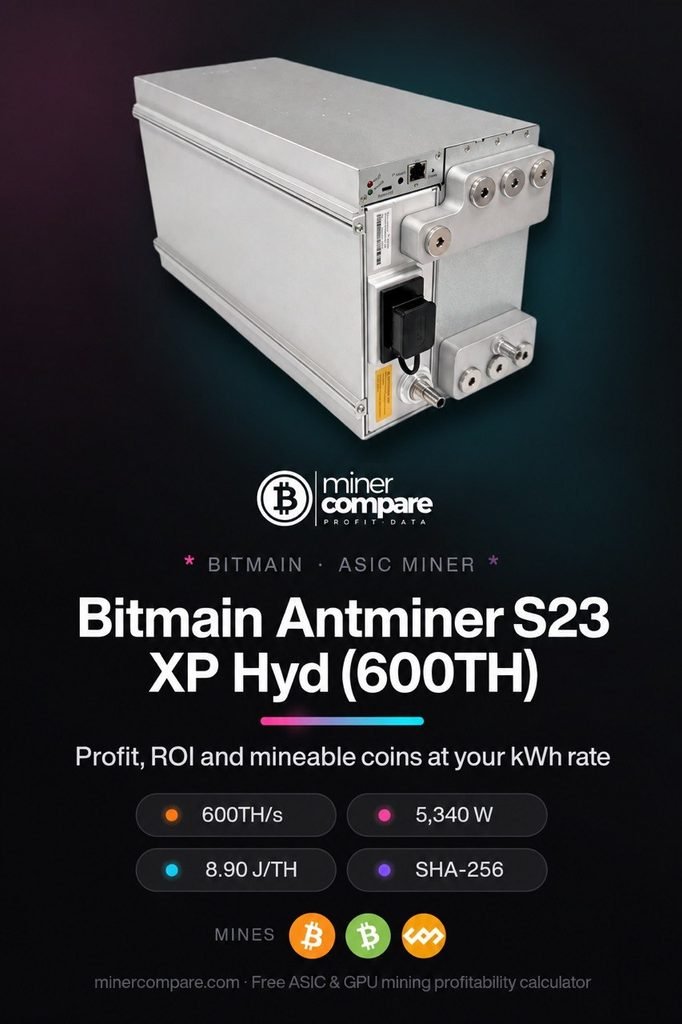
Model Identification. The number 600 refers to the miner’s hashrate in terahashes per second. It does not describe electricity consumption or the number of coins it can produce. The S23 XP Hyd should not be confused with the S23 Hyd, S23e U2H, or S23 Hyd 3U. Similar product names do not mean identical specifications, cooling requirements, or installation arrangements. When requesting a quotation, specify the complete model name and the 600 TH/s configuration, and ask the supplier to identify the exact version being offered. Appearance and Colour. In the supplied image, the miner has a rectangular silver-coloured metal enclosure with grey panels, visible fastening screws, a black electrical connector, and liquid-cooling connections. This describes the pictured unit rather than a verified selection of factory colour options. Alternative black, white, or other finishes cannot be confirmed. Its appearance is functional and industrial. However, a photograph alone cannot establish the exact model, condition, or contents of a shipment. Before purchasing, check the identification label, documentation, and details of the specific unit or production batch.
Dimensions and Weight.
Altair Technology’s detailed product listing gives the dimensions of the unpackaged miner as 409 × 176 × 208 mm, with a net weight of approximately 15.8 kg. The listed packaging dimensions are 570 × 316 × 430 mm, with a gross shipping weight of approximately 17.1 kg. These are supplier-published figures; they have not been independently checked against an accessible official manual for this exact version. (altairtech.io) In centimetres, the enclosure measures approximately 40.9 cm long, 17.6 cm wide, and 20.8 cm high. The space required for an installation will be greater than the enclosure dimensions because cables, coolant hoses, access to connections, and servicing clearance must also be accommodated. A shelf or cabinet should therefore be selected around the complete installation rather than the metal enclosure alone. Package Contents. One supplier, Rent A Rig, lists an included three-phase power supply. However, a complete, verified factory packing list is not available here. A power cable, adapters, hoses, fittings, spare seals, and coolant should not be assumed to be included unless the seller explicitly confirms them. (rentarig.io)
Request an itemized quotation identifying the miner, power supply, required electrical cables, and any cooling equipment included in the price. Ask whether the external heat exchanger, circulation pumps, and cooling controls are supplied as part of a package or must be purchased separately. A statement such as “ready to operate” should be supported by a clear equipment list. The purchase price of the miner alone does not establish the total cost of a working mining system. Hashrate and Performance. A hashrate of 600 TH/s represents approximately 600 trillion hash calculations per second on the supported mining algorithm. It measures computing performance, not a guaranteed payment rate. Mining output depends on network difficulty and the machine’s contribution to the network’s total computing power. A mining pool combines the work of participating miners and distributes rewards according to its payment rules. With solo mining, earnings depend on successfully finding a block, so an operator should not expect a steady payment every hour. (developer.bitcoin.org)
Power Consumption. BITMAIN lists approximately 5,340 W of power consumption for the 600 TH/s configuration, equivalent to 5.34 kW. (shop.bitmain.com)
Using that stated power level, continuous operation would consume approximately 5.34 kWh in one hour, 128.16 kWh in 24 hours, and 3,844.8 kWh over 30 days. These are calculations based on constant power and uninterrupted operation. They do not add the electricity used by external pumps or other cooling equipment. At an illustrative electricity price of $0.05 per kWh, the miner’s electricity cost would be approximately $6.41 per day and $192.24 over 30 days. At $0.10 per kWh, the corresponding costs would be approximately $12.82 per day and $384.48 over 30 days. At $0.20 per kWh, they would rise to approximately $25.63 per day and $768.96 over 30 days. These tariffs are examples, not statements about electricity prices in a particular country. Use the actual rate in your electricity contract when assessing a purchase. Energy Efficiency. The stated efficiency of 8.9 J/TH describes the energy required to perform a given amount of hashing work. Under comparable conditions, a lower figure indicates less energy used for the same computational output. (linkedin.com)
Efficiency is useful when comparing mining hardware, but it does not establish profitability by itself. Equipment cost, electricity tariffs, installation expenses, and changes in mining revenue must also be included. Electrical and Network Requirements. A published supplier specification lists three-phase power at 380–415 V, a frequency range of 50–60 Hz, and a maximum input current of 12 A. Network connectivity is listed as RJ45 Ethernet 10/100M. (globalsources.com)
These requirements mean the miner should not be treated as an appliance that can simply be plugged into a standard household outlet. The electrical supply, protective devices, grounding, wiring, and connectors need to be assessed by a qualified electrician. An improvised adapter does not replace a suitable electrical installation. A wired network connection and the correct pool configuration must also be prepared before operation. Liquid Cooling. Published specifications for the 600T-10 version list an inlet coolant temperature of 20–50°C and a coolant flow rate of 8–10 litres per minute. These values describe the cooling circuit, not the permitted room temperature. (learn.jglobalmining.com)
The flow rate does not mean that hundreds of litres of fresh water must be consumed every hour: in a closed-loop system, coolant circulates through the circuit. The installation must continuously transfer heat away from the equipment. For preliminary planning, the cooling design needs to account for a heat load on the order of the miner’s stated electrical power, together with any additional equipment. The required capacity margin, circuit arrangement, and coolant composition should be determined using the applicable documentation and installation design. Liquid cooling should not be interpreted as a promise of silent operation, since pumps and external heat-rejection equipment can still produce noise. Supported Cryptocurrencies. BITMAIN lists Bitcoin, Bitcoin Cash, and Bitcoin SV—BTC, BCH, and BSV—as supported SHA-256 mining currencies. (m.bitmain.com)
This is specialized hardware rather than a universal miner for every cryptocurrency. Compatibility is determined by the mining algorithm. Support for several currencies also does not mean that the machine automatically earns the full projected output of all of them simultaneously. When comparing mining options, use calculations from the same date, the same electricity tariff, and the actual terms of the pool you intend to use. How Much Bitcoin Can It Mine per Hour? There is no fixed hourly Bitcoin output in the hardware specifications, but an illustrative calculation can show how an estimate is produced. Assume a total network hashrate of exactly 1 ZH/s, an average of six blocks per hour, and a block subsidy of 3.125 BTC, excluding transaction fees. Under those assumptions, a 600 TH/s machine represents 0.0000006 of the network’s computing power. Multiplying that share by six blocks and 3.125 BTC gives approximately 0.00001125 BTC per hour, equivalent to 1,125 satoshis. Over 24 hours, the result would be approximately 0.00027 BTC. This is a hypothetical expected-output calculation, not a verified current earning rate or a guarantee of hourly payments. Actual network difficulty, pool fees, reward arrangements, rejected work, hashrate variations, and downtime will affect the result. Bitcoin’s mining documentation explains the relationship between computational work, difficulty, and block discovery. (developer.bitcoin.org)
Revenue and Operating Profit.
To estimate revenue in dollars, multiply the expected Bitcoin output by an assumed Bitcoin price, then subtract operating expenses. For example, at a hypothetical Bitcoin price of $80,000, the illustrative output of 0.00027 BTC per day would correspond to $21.60 in daily gross revenue. With electricity priced at $0.10 per kWh, subtracting the miner’s calculated electricity cost of $12.816 would leave approximately $8.78 per day. That amount is not net profit: it excludes external cooling electricity, pool fees, equipment purchases, shipping, maintenance, and other costs. At $0.20 per kWh, the miner’s electricity cost alone would exceed the same hypothetical gross revenue. Purchase Costs and Payback. A credible payback estimate requires the complete startup budget and several revenue scenarios. Include the miner, electrical preparation, cooling infrastructure, delivery, applicable import charges, installation, and any hosting deposit or recurring service fees. A useful assessment should consider lower revenue, higher expenses, and periods of downtime rather than assuming that one favourable day will repeat throughout the equipment’s life. Before paying, obtain written confirmation of the delivery schedule, warranty terms, repair procedure, return-shipping responsibility, and arrangements if shipment is delayed. Who Is It For? The Antminer S23 XP Hyd 600 is aimed at installations with suitable three-phase electrical infrastructure, liquid cooling, and technical support. Its stated hashrate and efficiency make it a model worth evaluating for professional mining operations, but the commercial result depends on the complete installation. A home installation requires a separate engineering and financial assessment. The miner should be evaluated as one component of a system in which electricity, cooling, pool configuration, maintenance, and purchase conditions all contribute to the final outcome.




Leave a Reply