
Why Bitcoin Is Falling? News February 2026
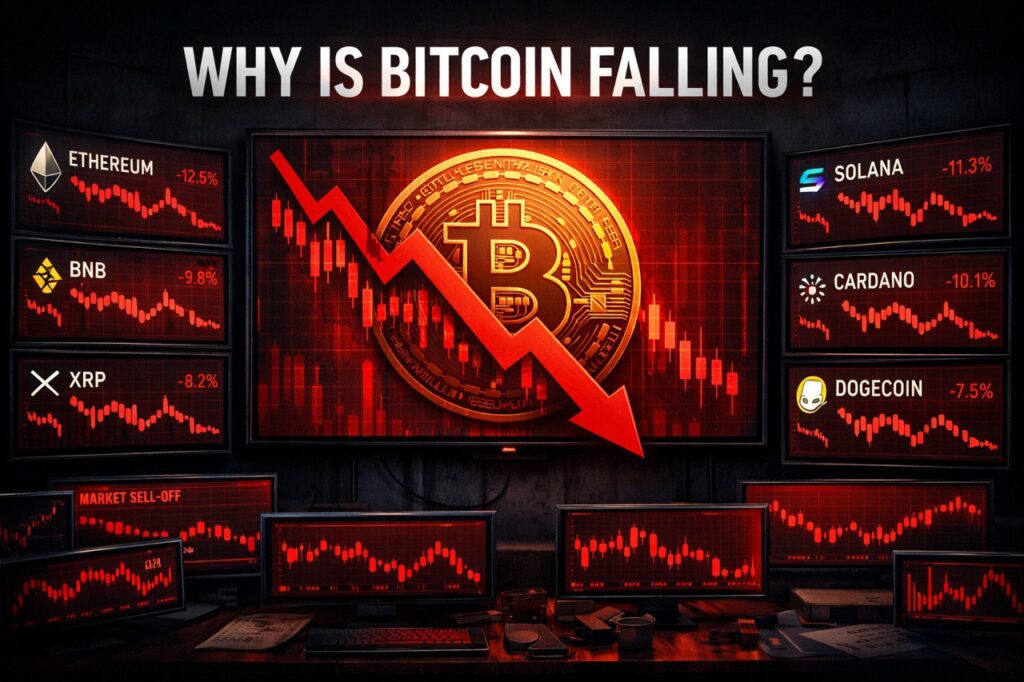
In recent days, Bitcoin has been declining, and this movement is driven not by a single factor but by a combination of market and geopolitical influences. The current correction is a typical example of how the crypto market reacts to global events and investor sentiment.
Macroeconomic Environment
Bitcoin is increasingly moving in correlation with other risk assets. Against the backdrop of global economic uncertainty, expectations around interest rates, and tightening liquidity conditions, investors are becoming more cautious. This reduces demand for highly volatile assets, including cryptocurrencies.
Capital Outflows and Profit-Taking
One of the notable factors has been a reduction in institutional inflows. Outflows from Bitcoin ETFs have been observed, along with active profit-taking following previous price increases. These outflows amount to billions of dollars, temporarily leaving the market or being reallocated into more conservative assets.
Technical Factors and Liquidations
The decline is being amplified by technical factors. When key support levels are broken, stop orders are triggered and leveraged positions are liquidated. This creates a chain reaction that accelerates downward price movement.
Geopolitical Impact

Escalating tensions in the Middle East, including developments related to Iran, are exerting indirect pressure on financial markets. Geopolitical uncertainty increases “risk-off” sentiment, prompting investors to reduce exposure to risky assets. During such periods, cryptocurrencies often face additional pressure despite the absence of fundamental issues.
Market Psychology
Negative news flow intensifies emotional reactions across the market. Some participants choose to exit positions early, fearing a deeper correction. This behavior is typical during periods of uncertainty and has occurred many times throughout Bitcoin’s history.
What to Do Next
For Long-Term Investors
Corrections of this scale have occurred many times in Bitcoin’s past. From a long-term perspective, it is important to:
• maintain discipline and avoid emotional decisions
• recognize the cyclical nature of the market
• use gradual accumulation strategies rather than single large entries
Such periods often represent phases of reassessment and base-building before the next major move.
For Short-Term Traders
In a high-volatility environment, it is advisable to:
• reduce position sizes
• avoid excessive leverage
• trade strictly according to predefined strategies and levels
The market remains technically complex, and sharp moves in either direction are possible.
For Beginners
The best approach is not to try to “catch the bottom,” but rather to:
• study market behavior
• understand the drivers behind price movements
• start with small amounts or observe before taking action
Bitcoin is a marathon, not a sprint.
Conclusion
The current decline in Bitcoin is the result of a combination of macroeconomic pressures, capital outflows, technical factors, and geopolitical uncertainty. Such phases are a natural part of the market cycle and do not negate Bitcoin’s long-term role as an independent financial asset.
If you want to stay up to date with important news in the crypto industry,
trade with lower risk, and be among the first to learn about new coins,
follow crypto news on our website.