
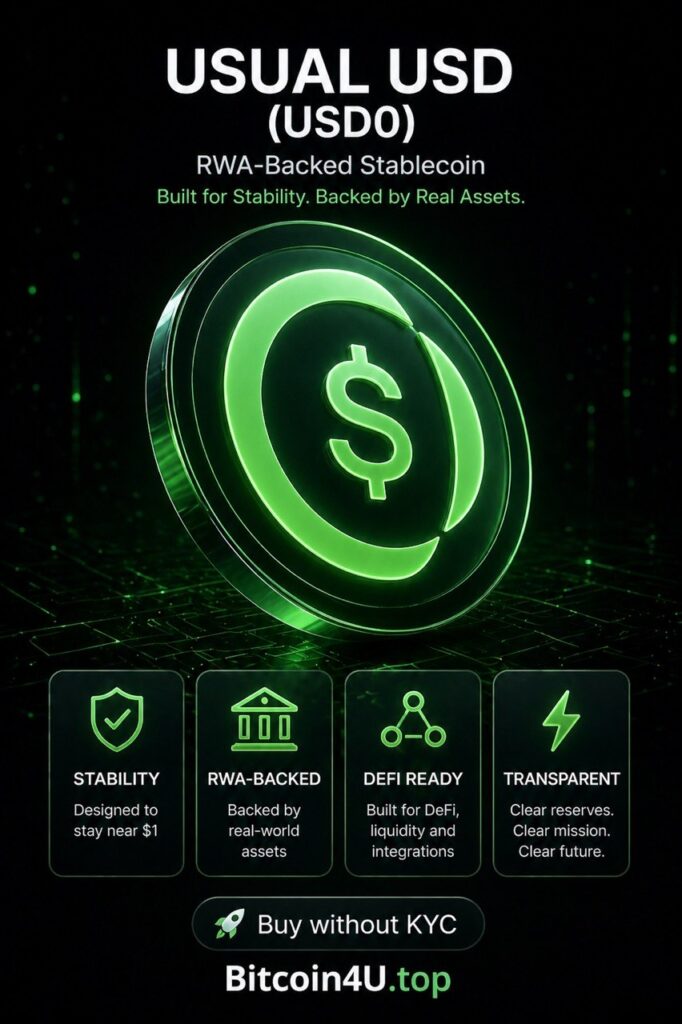
Learn how USD0 can be used for stable crypto earnings, passive income, and DeFi strategies. Ideal for users looking for low-volatility opportunities in crypto.
Usual USD (USD0) Reviews from Real Users
Usual USD, also known as USD0, is a stablecoin from the Usual ecosystem focused on real-world asset backing, transparency, and DeFi utility. Unlike many speculative cryptocurrencies, USD0 is designed to stay close to the value of 1 U.S. dollar while giving users access to stablecoin liquidity, RWA exposure, and decentralized finance opportunities.
📍 Jump to
🧠 What Is Usual USD (USD0)?
USD0 is a stablecoin created within the Usual ecosystem. Its main goal is to provide a stable digital dollar backed by real-world assets and usable across DeFi platforms. It belongs to the growing RWA category, where traditional financial assets are brought into crypto through tokenization.
For many real users, USD0 represents a possible alternative to traditional centralized stablecoins. It is not designed for aggressive price growth, but for stability, liquidity, transparency, and participation in decentralized finance.
📜 History of Usual USD
USD0 was introduced as part of the Usual protocol, a project focused on building a more transparent stablecoin model backed by real-world assets. The protocol entered the market during the rise of RWA crypto, when users started looking for stablecoins with clearer backing and more on-chain utility.
The idea behind Usual USD is to create a stable asset that can be used in DeFi while also connecting users to real-world financial infrastructure. This makes USD0 different from meme coins, high-volatility altcoins, and ordinary speculative tokens.
💰 USD0 Price Model
USD0 is designed to stay close to 1 U.S. dollar. Since it is a stablecoin, its goal is not to pump in price like a meme coin or grow like a speculative altcoin.
The value of USD0 comes from stability, reserve structure, liquidity, and DeFi usability. Users typically look at USD0 as a digital dollar for holding value, participating in DeFi, and accessing RWA-backed stablecoin strategies.
⚙️ How to Get USD0
There are several ways users can get USD0, depending on platform support, wallet access, and available DeFi integrations.
✅ Main ways to get USD0
Buying or swapping USD0 on supported platforms
Using DeFi protocols that support USD0
Providing liquidity in supported pools
Participating in the Usual ecosystem
Using USD0 as a stable asset inside crypto strategies
⚠️ What users should know
USD0 is not mined like Bitcoin
It is designed to stay near $1
Liquidity can depend on market demand
Stablecoins still carry reserve and protocol risks
For beginners, the easiest way to get USD0 is usually by swapping or buying it through a supported platform. More advanced users may use USD0 in DeFi strategies, liquidity pools, stablecoin farming, or RWA-focused crypto portfolios.
📊 How Much USD0 Is There and Who Holds the Most?
USD0 does not have a fixed maximum supply like Bitcoin. Its supply depends on issuance, redemptions, demand, reserves, and activity inside the Usual ecosystem.
Major holders may include DeFi users, liquidity providers, stablecoin investors, ecosystem participants, crypto funds, and wallets using USD0 for RWA-backed stablecoin strategies.
For many investors, the most important question is not the maximum number of tokens, but whether USD0 can maintain liquidity, transparency, reserve quality, and a stable peg to the U.S. dollar.
⭐ Trust in USD0 Among Real Users
User trust in USD0 is built around the idea of real-world asset backing, stablecoin transparency, and DeFi utility. Many users are interested in USD0 because it offers a different model from traditional centralized stablecoins.
✅ What users like
Stablecoin structure close to 1 USD
Real-world asset narrative
DeFi and liquidity use cases
Alternative to traditional stablecoins
⚠️ What users dislike
Newer project risk
Reserve and liquidity concerns
Not designed for price growth
Requires understanding of DeFi and RWA risks
In user reviews, USD0 is often described as a stablecoin for people who want digital dollar exposure, RWA backing, and DeFi opportunities rather than high-risk speculative trading.
✍️ Write a Review About USD0
Have you used USD0 or the Usual ecosystem? Share your experience to help other users understand how this stablecoin works in real life.
You can write about liquidity, swaps, DeFi strategies, stablecoin yield, wallet experience, peg stability, and whether USD0 fits your crypto portfolio.
Leave Your Review🔎 People also search
❓ FAQ — Usual USD (USD0) Reviews from Real Users
What is USD0 in simple words?
USD0 is a stablecoin from the Usual ecosystem designed to stay close to 1 U.S. dollar and connected to real-world asset backing.
Why do people use USD0?
People use USD0 because it offers stablecoin utility, RWA exposure, DeFi use cases, and an alternative to traditional centralized stablecoins.
Can beginners get USD0 easily?
Beginners can get USD0 through supported platforms, but they should understand stablecoin risks, wallet safety, liquidity, and DeFi basics before using it.
Is USD0 still worth using?
USD0 may be useful for users who want a stablecoin with RWA backing and DeFi opportunities, but every decision depends on liquidity, risk tolerance, and personal strategy.
Does USD0 have a fixed supply?
No. USD0 supply can change depending on issuance, redemptions, market demand, and activity inside the Usual ecosystem.
Who owns the most USD0?
Major holders may include DeFi users, liquidity providers, stablecoin investors, ecosystem participants, crypto funds, and wallets using USD0 in stablecoin strategies.
Can you mine USD0?
No. USD0 is not mined like Bitcoin. It is a stablecoin created through protocol mechanisms, reserves, issuance, and redemption processes.
What is the safest way to use USD0?
The safest approach is to use trusted platforms, understand reserve and liquidity risks, avoid overexposure, protect private keys, and monitor stablecoin peg stability.
© Bitcoin4U.top • Educational content • Not financial advice
✍️ Share Your Experience
Have you used this coin? Share your opinion and help others make better decisions.
