
Breaking down my portfolio: long-term holdings, altcoins, high-growth picks, and real ways to earn from crypto
In this article, I’ll take you through my current crypto portfolio in detail: which coins, tokens, and altcoins I hold for the long term, as well as which assets I use for short-term gains and potential high returns. I’ll also show, for each coin, all available ways to earn — from mining and farming to trading and staking for yield.
In the current environment of geopolitical uncertainty and global economic instability, cryptocurrency is increasingly proving itself as one of the more resilient and independent asset classes. That’s why proper portfolio allocation is becoming a key factor in both preserving and growing capital.
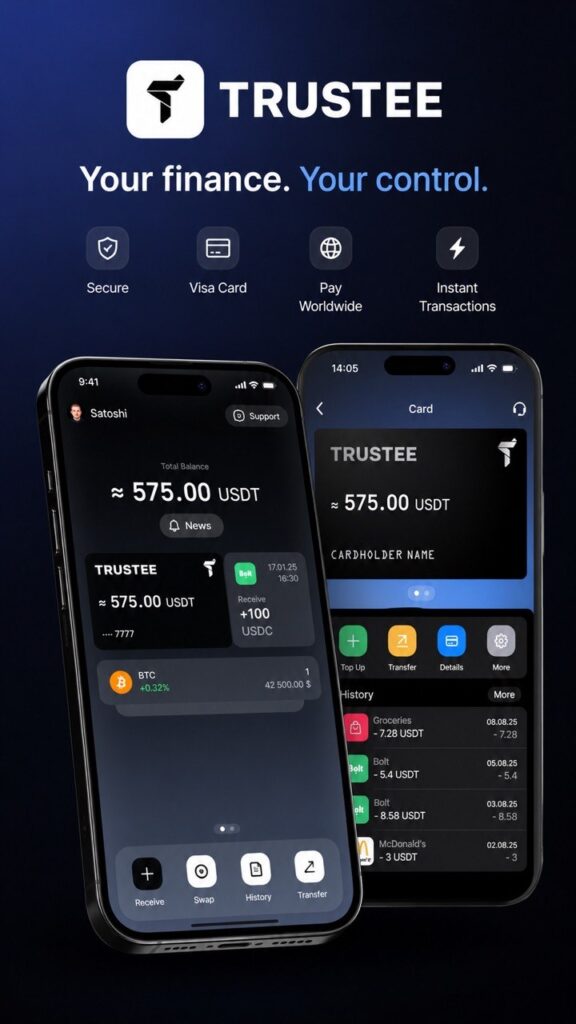
I’ll start with an important recommendation. Personally, I use the Trustee Plus crypto wallet — a versatile solution that allows you not only to securely store your crypto, but also to issue a virtual Visa card, instantly convert crypto into fiat, and pay with it anywhere in the world. This is especially convenient if you earn income in cryptocurrency and want to use it in everyday life.
My Crypto Portfolio: Which Coins Are Already Generating Profit?
This list features coins from my crypto portfolio presented in no particular order. For each asset, you’ll find a brief description, current ranking, and all available earning methods — including mining, staking, trading, and other profit strategies.
USD Coin (USDC)
One of the main assets in my crypto portfolio is USD Coin (USDC), one of the most reliable stablecoins pegged to the US dollar at a 1:1 ratio. This asset is widely used for storing value, transfers, and everyday payments within the crypto ecosystem.
USDC was launched in 2018 by Circle in partnership with Coinbase under the Centre consortium. The main goal of the project was to create a transparent and regulated stablecoin fully backed by US dollar reserves. Unlike many other stablecoins, USDC undergoes regular audits, which increases trust among users and institutional investors.
USDC is a digital dollar, used for storing value, making transfers, trading, and interacting with DeFi applications. Its stability helps minimize volatility risks while allowing fast and efficient movement of funds across the crypto market.
In my case, I actively use USDC in the Trustee Plus wallet, where this coin is linked to a virtual card. This allows me to pay for goods and services anywhere in the world, instantly converting crypto into real payments. This makes USDC an extremely convenient tool for everyday use.
You can earn USDC through staking and interest programs, as well as through trading. Its main advantages are stability and high liquidity, making it one of the key assets for capital management.
Why I Hold USD Coin (USDC)?
I choose USDC primarily for holding funds on a card and making everyday payments. It is a stable digital dollar that can be easily used in real life without unnecessary conversions or risks.
USDC is a reliable and practical asset for storing and using funds, making it an essential part of everyday crypto usage.
USDT (Tether)
The second coin in my portfolio is USDT (Tether), which makes up more than 35% of my total crypto assets. It serves as a core stablecoin in my crypto portfolio 2026, allowing me to preserve capital, reduce volatility, and quickly react to market opportunities. At the moment, my USDT is allocated in flexible savings on the CoinEx exchange, generating around 13.25% annual yield. The key advantage is liquidity — funds can be withdrawn at any time, which allows me to instantly deploy capital during market corrections and buy undervalued cryptocurrencies to grow my portfolio.
USDT was originally launched in 2014 by Tether Limited under the name Realcoin, later rebranded as Tether. It was designed as a stablecoin pegged to the US dollar (1:1), providing traders with a way to stay in the crypto market without exposure to price volatility. Today, USDT is one of the most widely used digital assets, playing a crucial role in crypto trading, liquidity, and portfolio management.
There are multiple ways to earn USDT, making it one of the most versatile assets in the crypto ecosystem. You can receive USDT through crypto faucets and earning websites, use mobile and desktop apps that reward users in USDT, mine cryptocurrencies on a home PC and convert them into USDT, actively trade on exchanges, or generate passive income through staking and flexible savings with interest. This flexibility makes USDT an essential tool for both beginners and advanced investors looking for stable returns.
Tether (USDT) remains one of the best assets for any crypto portfolio due to its stability, liquidity, and wide range of earning
Top! Canton (CC)
The Canton (CC) coin is already ranked ≈ #20 on CoinMarketCap, and today we’ll break down this token: what the project is, how it works, and whether it’s worth paying attention to.
Canton is one of the most unique projects in the crypto market, designed not for everyday users but for banks, financial institutions, and the real-world asset (RWA) sector. Unlike most cryptocurrencies, it was built as infrastructure to bridge traditional finance (TradFi) with blockchain technology.
The project was announced in 2023, when major companies including Microsoft, Goldman Sachs, and Deloitte came together to develop a new network. Their goal was to create a blockchain that banks could use without risking data exposure. This became a key difference between Canton and networks like Bitcoin or Ethereum, where all data is public.
The core idea behind Canton is a partially private blockchain. This means participants only see the data relevant to their transactions while still being part of a shared network. This approach makes the platform especially attractive for institutional players where confidentiality is critical.
The mainnet was officially launched in July 2024, marking the transition from concept to a fully operational infrastructure. Around the same time, the CC token was introduced, serving as the backbone of the ecosystem for transaction fees, validator incentives, and network operations.
Interestingly, Canton did not follow the typical ICO route or rely on aggressive marketing. The token launch was relatively “clean,” without heavy venture capital pressure, which sets it apart from many other crypto projects.
The token entered the market in late 2025, with an initial price of approximately $0.11. In the first days of trading, it surged to around $0.18, followed by a correction. Since then, the price has stabilized in the $0.14–$0.17 range, indicating growing market interest and liquidity.
The all-time high (ATH) reached approximately $0.19, while the lowest levels dropped to around $0.05–$0.06. Such volatility is typical for newer assets during early market formation.
Canton’s tokenomics are based on a burn + mint model. Tokens are burned through network usage and newly minted as rewards. This creates a direct link between network activity and token demand — the more the network is used, the stronger the potential price support.
Another key area of development is the RWA (Real World Assets) sector. Canton enables tokenization of assets such as real estate, bonds, gold, and credit instruments. This sector is currently one of the fastest-growing trends in the crypto industry.
Important to note:
At the moment, this token cannot be mined or earned through crypto faucets. However, there is a great alternative — using apps that allow you to earn USDT, which can later be exchanged on the CoinEx exchange without mandatory verification at the current market rate.
As of 2026, Canton is already seen as a serious infrastructure-level project. The token price remains around $0.14–$0.16, with a market capitalization of several billion dollars. The project continues to develop and attract attention from major financial players.
To be clear, Canton is not about quick gains or hype. It represents a long-term bet on the future of finance, where blockchain technology becomes integrated into institutional systems.
That is why Canton (CC) is considered one of the projects that could play a significant role in the next phase of the crypto market — and it can be taken seriously as a potential addition to a diversified crypto portfolio.
Hedera (HBAR)
The next asset in my crypto portfolio is Hedera (HBAR), which is currently ranked ≈ #28 on CoinMarketCap. It is one of the most technologically advanced projects in the crypto space and is often considered an alternative to traditional blockchains. Instead of using a standard blockchain, Hedera is built on Hashgraph technology, which provides high speed, strong security, and extremely low transaction fees. Thanks to this architecture, the network can process thousands of transactions per second with near-instant finality, making it highly attractive for scalable and enterprise-level solutions.
The project was founded in 2017 by Leemon Baird, with the mainnet launching in 2019. From the beginning, Hedera has focused on enterprise adoption, which is why its governance model includes a council of major global companies such as Google, IBM, and Boeing. This structure adds a layer of credibility, stability, and long-term trust to the project.
HBAR is the native token of the network, used to pay transaction fees, power smart contracts and decentralized applications, and secure the network through staking. As a result, the token plays a fundamental role in maintaining and operating the entire ecosystem.
There are multiple ways to earn with HBAR, including trading on crypto exchanges, long-term holding as an investment, staking for passive income, and participating in the Hedera ecosystem through dApps. It is also commonly used as a diversification asset within a crypto portfolio, thanks to its strong technological foundation and institutional backing.
Among its key advantages are high transaction speed, low fees, a stable infrastructure, and a clear focus on real-world use cases. However, there are also risks to consider — the technology can be complex for new users, the project depends on enterprise adoption, and it faces strong competition from networks like Ethereum and Solana.
Hedera (HBAR) is a powerful technology-driven project with real-world applications, making it a valuable addition to a diversified crypto portfolio due to its efficiency, scalability, and strong institutional support.
Top! Stellar (XLM)
The next asset in my crypto portfolio is Stellar (XLM), which occupies ≈ #21 place on CoinMarketCap. It is one of the most well-known projects focused on fast and low-cost international payments. Stellar is often compared to Ripple, but unlike it, the network is more oriented toward everyday users and providing access to financial services worldwide.
The next asset in my crypto portfolio is Stellar (XLM), which occupies #18 place on CoinMarketCap. It is one of the most well-known projects focused on fast and low-cost international payments. Stellar is often compared to Ripple, but unlike it, the network is more oriented toward everyday users and providing access to financial services worldwide.
The project was created in 2014 by Jed McCaleb (co-founder of Ripple) with the goal of making cross-border payments faster, cheaper, and more accessible. The Stellar network enables near-instant transactions with extremely low fees and also acts as a bridge between different currencies and assets.
XLM is the native token of the network, used to pay transaction fees, prevent spam, and serve as an intermediary asset for exchanging value within the ecosystem.
It is important to understand that Stellar cannot be mined in the traditional way, as it does not use Proof-of-Work. All tokens were created at launch, and no new coins are generated through mining.
However, there are alternative ways to earn XLM, including free methods. You can earn XLM through trading, long-term investing, participating in the Stellar ecosystem, as well as through crypto faucets, airdrops, mobile and desktop apps, and online platforms that reward users with small amounts of cryptocurrency. It is also possible to mine other cryptocurrencies on a home PC and convert them into XLM.
Among its key advantages are extremely low transaction fees, high speed, and ease of use for international transfers. Stellar is already used in real-world financial applications and continues to expand its ecosystem.
Stellar (XLM) is a practical and accessible asset that can serve as a stable part of a crypto portfolio while also offering multiple earning opportunities.
 Advertisement | Sponsored:
Mantle (MNT)
The next asset in my crypto portfolio is Mantle (MNT), which occupies ≈ #40 place on CoinMarketCap. It is a modern infrastructure project focused on scaling Ethereum and developing a robust ecosystem of decentralized applications.
Mantle is a Layer 2 solution designed to increase transaction speed and significantly reduce fees on the Ethereum network. The project is actively developing, supported by a strong community, and closely connected to the BitDAO ecosystem, which provides additional funding and long-term stability.
MNT is the native token of the network, used for transaction fees, governance, and participation in the ecosystem. Thanks to its architecture, Mantle enables scalable and efficient solutions, making it a promising asset within a long-term crypto strategy.
It is important to note that Mantle cannot be mined, and there are currently no faucets or free ways to earn this token. The primary way to acquire MNT is through purchasing it on cryptocurrency exchanges and holding it as part of a portfolio.
You can generate profit with Mantle through long-term investing and active trading. In my case, it is used as a strategic asset with a focus on future growth and ecosystem expansion.
Why I Hold Mantle (MNT) ?
I hold Mantle because it is an Ethereum-based infrastructure project that solves real scalability issues. It has strong financial backing, ecosystem support, and clear growth potential as Layer 2 solutions continue to expand. For me, this is a bet on technology and the future of blockchain, not just a speculative asset.
Mantle (MNT) is a promising infrastructure asset that can be considered a valuable part of a long-term crypto portfolio focused on technological growth.
Dogecoin (DOGE)
My favorite meme token is Dogecoin (DOGE), which occupies ≈ #10 place on CoinMarketCap. It has been part of my crypto portfolio since 2015, and over the years it has generated significant profit for me thanks to its strong growth cycles and massive popularity in the market.
Dogecoin was created in 2013 by Billy Markus and Jackson Palmer as a joke project inspired by the Shiba Inu meme. However, over time it evolved into a major cryptocurrency with a large community and support from well-known figures, including Elon Musk. Due to its simplicity and accessibility, Dogecoin has become one of the most recognizable digital assets in the world.
DOGE is a decentralized cryptocurrency used for fast and low-cost transactions, and it is widely utilized for tips, micropayments, and transfers.
There are multiple ways to earn Dogecoin. It can be obtained through mining, since the network operates on a Proof-of-Work algorithm, through crypto faucets and online platforms that distribute small amounts for free, as well as through trading and long-term holding. Some platforms also offer passive income options, including interest programs and staking-like services.
Why I Hold Dogecoin (DOGE)?
The main reason I hold DOGE is that it is a time-tested meme token that has maintained its position among the top cryptocurrencies for many years. It represents about 20% of my crypto portfolio and consistently demonstrates strong growth cycles while remaining highly liquid and widely recognized.
Dogecoin (DOGE) is a powerful meme-based asset with a proven track record, combining strong community support, liquidity, and long-term growth potential.
Top! Tron (TRX)
The next asset in my crypto portfolio is TRON (TRX), which occupies ≈ #8 place on CoinMarketCap. It is one of the most popular blockchain projects focused on fast transactions and the development of decentralized applications.
The project was founded in 2017 by Justin Sun, with the mainnet launched in 2018. The initial price of TRX was approximately $0.001–0.002, and since then the project has grown significantly, becoming a key infrastructure layer in the crypto industry.
TRON is a high-performance blockchain that offers very fast transactions and near-zero fees, making it widely used for transfers, DeFi applications, and especially for working with stablecoins like USDT.
TRX is the native token of the network, used for transaction fees, interacting with dApps, governance participation, and generating passive income through staking.
There are multiple ways to earn TRON, including trading on exchanges, staking for yield, as well as through crypto faucets and online platforms that distribute small amounts of TRX. It is also possible to mine other cryptocurrencies on a home PC and convert them into TRX, which is often considered an alternative way of mining.
Why I Hold Tron (TRX)?
I choose TRON for its stability, growth potential, and extremely fast transactions. It is one of the most convenient blockchains for everyday use, especially for transfers and working with stablecoins. In addition, the project has a strong ecosystem, high liquidity, and continuous development, making it a reliable asset in a crypto portfolio.
Avalanche (AVAX)
The next asset in my crypto portfolio is Avalanche (AVAX), which occupies ≈ #27 place on CoinMarketCap. It is one of the fastest and most advanced blockchain projects, focused on building scalable decentralized applications and financial solutions.
The project was launched in 2020 by Ava Labs under the leadership of Emin Gün Sirer. The initial price of AVAX was approximately ≈ $5, after which the token experienced significant growth and secured its position among leading crypto assets. Avalanche was designed as an alternative to Ethereum, aiming to solve issues related to scalability, speed, and high transaction fees.
Avalanche is a high-performance platform capable of processing thousands of transactions per second with near-instant finality. One of its key features is the ability to create custom blockchains (subnets), making the network highly flexible and attractive for developers and businesses
AVAX is the native token of the network, used for transaction fees, staking, securing the network, and interacting with decentralized applications.
There are multiple ways to earn AVAX, including trading, staking for yield, and participating in DeFi projects within the Avalanche ecosystem. Direct mining is not available, but alternative methods can be used — such as mining other cryptocurrencies on a home PC and converting them into AVAX.
Why I Hold Avalanche (AVAX)?
I choose Avalanche for its high speed, scalability, and strong growth potential. It is one of the projects actively competing with Ethereum by offering faster and more cost-efficient solutions. In addition, it has a strong ecosystem, active developer support, and the flexibility provided by subnets, which makes it a valuable long-term asset.
Tether Gold (XAUT)
Now let’s take a look at Tether Gold (XAUT) — a tokenized gold asset that holds a strong position among digital assets backed by real-world value. It is one of the few cryptocurrencies directly linked to physical gold.
The project was launched in 2020 by Tether. Each XAUT token is backed by one troy ounce of physical gold, stored in secure Swiss vaults. This means that owning XAUT is essentially equivalent to owning real gold, but in a digital and easily transferable form.
XAUT is a digital asset pegged to the price of gold, allowing investors to preserve capital and hedge against inflation and crypto market volatility. Unlike traditional gold, it can be transferred instantly, stored in a crypto wallet, and used within the broader crypto ecosystem.
You can profit from XAUT through long-term holding, trading, and using it as a hedge asset within a diversified portfolio. Mining and faucets are not available for this token, as it is fully backed by a physical resource.
Why I Hold Tether Gold (XAUT)?
I hold XAUT as digital gold that adds stability to my crypto portfolio. It helps protect capital during market uncertainty and provides diversification through a real-world backed asset.
Bitcoin Cash (BCH)
One of the core coins in my crypto portfolio is Bitcoin Cash (BCH), which holds a strong position in the market and remains one of the most well-known forks of Bitcoin.
Bitcoin Cash was created in 2017 as a result of a hard fork of Bitcoin. The main reason for the split was to increase the block size and make transactions faster and cheaper. Unlike Bitcoin, BCH was designed to function primarily as a payment system, rather than just a store of value.
The initial price of Bitcoin Cash after launch was approximately ≈ $240–300, and since then the coin has gone through multiple growth cycles and corrections, while remaining a recognizable and liquid asset in the crypto market.
BCH is a decentralized cryptocurrency used for fast and low-cost transactions. Thanks to its larger block size, the network can process more transactions with lower fees compared to Bitcoin.
There are several ways to earn Bitcoin Cash, including mining, since it operates on a Proof-of-Work algorithm, trading, and long-term holding. In addition, there are crypto faucets and online platforms that allow users to earn small amounts of BCH for free.
Why I Hold Bitcoin Cash (BCH)?
I hold Bitcoin Cash as a time-tested asset that remains highly practical for fast payments and transfers. It combines the recognition of Bitcoin with lower fees and faster transaction speeds.
Bitcoin Cash (BCH) is a practical and reliable asset that can be used both for everyday transactions and as part of a well-balanced crypto portfolio.
Cardano (ADA)
One of the core coins in my crypto portfolio is Cardano (ADA), which holds a strong position in the market and is known as one of the most advanced blockchain projects focused on long-term development.
Cardano was launched in 2017 by Charles Hoskinson, one of the co-founders of Ethereum. The project was built using a scientific and research-driven approach, making it one of the most structured and carefully developed cryptocurrencies in the industry.
The initial price of Cardano after launch was approximately ≈ $0.02–0.03, and since then the coin has gone through multiple growth cycles, reaching significantly higher levels and maintaining strong recognition in the crypto market.
ADA is a decentralized cryptocurrency designed for secure, scalable, and efficient transactions. It uses a Proof-of-Stake algorithm (Ouroboros), which allows users to participate in the network and earn rewards without the need for mining equipment.
There are several ways to earn Cardano, including staking, which is the main method of generating passive income, trading, and long-term holding. Unlike mining-based coins, ADA does not support traditional mining, but offers a more energy-efficient alternative through staking.
Why I Hold Cardano (ADA)?
I hold Cardano as a fundamentally strong and long-term asset with solid development and real use cases. It offers passive income through staking, has a strong team behind it, and continues to grow as a reliable part of a balanced crypto portfolio.
❓ FAQ — My Crypto Portfolio 2026
What is a crypto portfolio and how does it work?
A crypto portfolio is a collection of cryptocurrencies held for investing, trading, staking, and generating profit. A balanced portfolio usually includes Bitcoin, stablecoins, and selected altcoins with strong growth potential.
How can a crypto portfolio generate daily profit?
A crypto portfolio can generate daily profit through staking, trading, flexible savings, passive income programs, and short-term market opportunities. The key is combining stable assets with selected growth coins.
Which coins are best for a crypto portfolio in 2026?
The best crypto portfolio in 2026 usually includes Bitcoin, Ethereum, stablecoins like USDT and USDC, and promising altcoins such as TRON, Avalanche, Hedera, Mantle, and other assets with real utility and strong market positions.
Can I earn passive income with crypto in 2026?
Yes. Passive income with crypto is possible through staking, interest-bearing savings accounts, stablecoin yield programs, and selected DeFi opportunities. Many investors use these methods to grow their portfolios over time.
Is it possible to mine crypto on a home PC?
Yes. Some cryptocurrencies can still be mined on a home PC, and the mined coins can later be converted into assets like USDT, TRX, XLM, or other coins inside your crypto portfolio strategy.
What are crypto faucets and do they still work?
Crypto faucets are websites and apps that reward users with small amounts of cryptocurrency for completing simple tasks. They still work in 2026 and can be used as an additional way to earn Bitcoin, Dogecoin, TRON, and other coins.
How do beginners start building a crypto portfolio?
Beginners usually start by buying stablecoins like USDT or USDC, adding Bitcoin for long-term holding, and then selecting a few promising altcoins. Staking, trading, and passive income apps can be added gradually.
What is the safest crypto portfolio strategy?
One of the safest approaches is diversification: combining stablecoins for liquidity, top coins for stability, and selected altcoins for growth. This helps reduce risk while preserving profit potential.
Can I use crypto for everyday payments?
Yes. With wallets like Trustee Plus and virtual crypto cards, you can store coins such as USDC and pay for goods and services worldwide, making crypto useful not only for investing but also for daily spending.
Why is a crypto portfolio important in 2026?
In 2026, a crypto portfolio is important because it provides flexibility, diversification, and multiple earning options. In times of economic uncertainty, crypto remains one of the most dynamic asset classes for growth and income.